SEO vs Social Media Marketing: Do I Need Both for My Business?

Updated: Jun 24

If you’re a service-based business owner, you’ve probably asked this question at some point:
“Do I need both SEO and social media marketing, or can I just focus on one?”
And honestly, it’s a fair question.
Most business owners are juggling limited time, limited energy, and a long list of things they should be doing to get clients online. Marketing often feels like another full-time job on top of running the actual business.
So the real question underneath this is usually:
Where should I focus my time?
What actually brings in clients?
What works long-term instead of just short bursts of visibility?
And the reality is, there is no “set it and forget it” magical marketing strategy. Every marketing channel takes time, effort, consistency, and investment to work well.
The key is choosing the strategy that makes the most sense for your business, your goals, your capacity, and the way your clients actually search for services.
This blog breaks everything down in simple, practical terms so you can make a clear decision based on your actual business goals, not on marketing overwhelm.
And I’ll also share my own perspective: for most service-based businesses, SEO (Search Engine Optimization) should be your focus. And no, not just because I design websites for a living (*wink, wink*)
It’s also not because social media isn’t useful.
The reason I recommend focusing on SEO is because it’s usually what brings in the most ready-to-buy clients with the least ongoing effort over the long-term. In fact, organic search drives 53% of website traffic, while social media accounts for around 5% on average.
As a service provider, your business exists to solve real problems for real people.
Maybe your clients are:
first-time home buyers trying to make confident decisions
families trying to plan for retirement with more security
business owners trying to get clarity around year-end finances
or service providers who are simply overwhelmed and need expert guidance
In every case, people aren’t just buying a service — they’re looking for a solution to something that’s already on their mind.
That’s where your marketing matters most.
Showing up where people already need you is what makes your marketing most effective.
If you’re a solo business owner or leading a small team, your time is limited. You don’t need another marketing “to do” list — you need a clear way to show people how you help solve their problems in a way that actually brings them to you.
Table of Contents:
If You Need Consistent Clients and Predictable Revenue, Focus on SEO
If You Need Fast Visibility or a New Brand to Get Noticed, Use Social Media
If You Have a New Website, Start with SEO, Support with Social Media
If You Need Consistent Leads, Sales, and Predictable Revenue, Focus on SEO
If You Want Short-Term Attention (Launches or Promotions), Use Social Media
If You’re Working with Time or Budget Constraints, Start with SEO
If You Want Real Growth Instead of Short-Term Wins, Start with SEO
Why SEO Matters More for Service-Based Businesses (My Perspective)
What is Search Engine Optimization (SEO)?

SEO stands for Search Engine Optimization.
Put simply, SEO means making your website easier for search engines like Google to understand and match with relevant searches, so your business shows up when people search for the services you offer.
For example, someone might search for:
“Mortgages for first-time home buyers”
“Financial planner near me”
“how to build a retirement savings fund”
SEO helps your website appear in those search results.
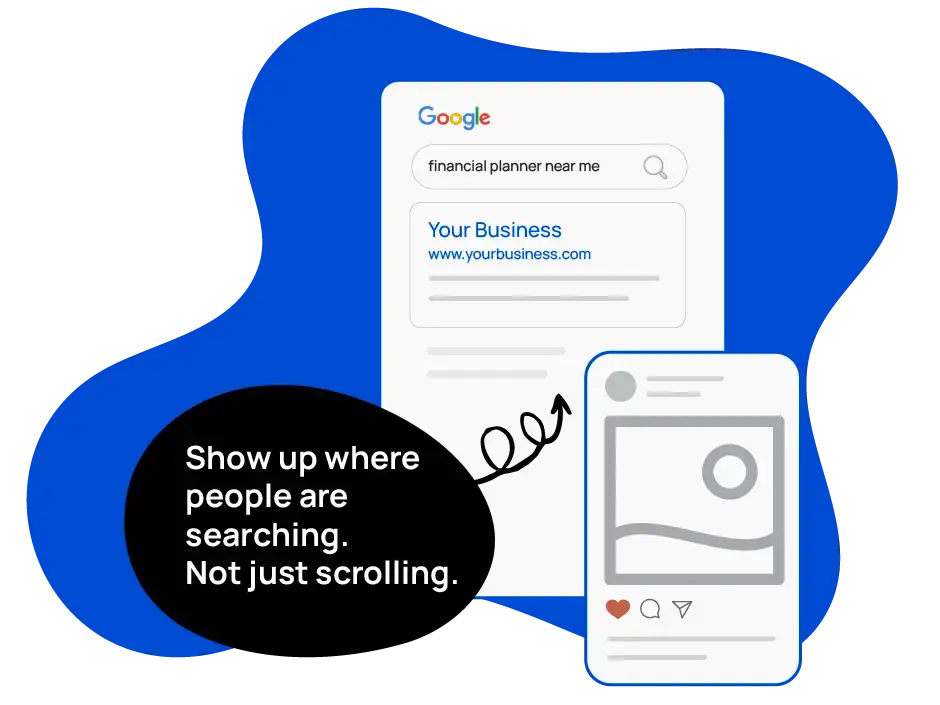
And that matters because when people search for services online, they’re usually looking for help with a problem they already know they have. That means SEO connects your business with people who are actively looking for solutions, not just casually scrolling.
Why search rankings matter for your business
At its core, SEO is not just about showing up online, it’s about showing up at the exact moment someone is looking for what you offer.
When your website shows up on the first page of Google, especially near the top, you naturally get:
more clicks
more visibility
more trust from potential clients
Most people don’t scroll far past page 1.
So ranking well can make a huge difference in how many inquiries you get.
That’s what makes it one of the most effective long-term marketing strategies for service-based businesses.
SEO in 2026: It’s Bigger Than Just Your Website

That said, SEO in 2026 is no longer limited to only what’s written on your website.
Search engines and AI-powered search tools now look at:
your website
your social media profiles
your Google Business Profile
online reviews
directory listings
and other public content connected to your business
This helps search engines understand:
who you are
what you do
whether your business appears trustworthy and active online
That’s why having consistent branding, messaging, and information across all platforms matters.
But your website is still doing the heavy lifting.
Your website is where:
your services are explained clearly
your content lives
your authority is built
and conversions happen
So while social media can support visibility, strong website SEO foundations are still one of the most important parts of a long-term marketing strategy for small businesses.
SEO Is Not About “Tricking Google”
One of the biggest misconceptions about SEO is that it’s about manipulating Google or trying to “beat the algorithm.”
Good SEO is much simpler than that.
SEO is about:
making your website clear
answering real questions people are searching for
structuring your content so both people and search engines can understand it
That’s it.
At its core, SEO is really about understanding what problems your audience is trying to solve and creating helpful content around those problems.
Because when your website consistently answers the questions people are already searching for, it signals to Google that your business is trustworthy, relevant, and knowledgeable in your industry.
And that’s what helps your business show up more often when potential clients are looking for help online.
The Role of SEO in Modern Digital Marketing
SEO plays a very specific role in your marketing strategy. It connects you with people who are already looking for what you do.
This is what makes SEO such a powerful marketing tool.
Instead of interrupting someone’s day (like social media often does), SEO meets people at the exact moment they need help.
That difference matters a lot.
SEO as a Long-Term Traffic Driver

One of the biggest benefits of SEO is that it compounds over time.
That means you publish a blog post or optimize a page once and it can continue showing up in search results for months or even years.
Unlike social media posts that disappear quickly, SEO content keeps working in the background.
It’s important to keep in mind that SEO is a long game. Results take time, and most websites need 3-6 months before seeing any shift in search results. But, once momentum begins to build, you start to see a compounding effect, where traffic can become relatively predictable and stable.
Think of SEO like planting seeds:
it takes time to grow
but once it does, it keeps producing results
SEO’s Impact on Bottom-Funnel Users

In marketing, “bottom of funnel” simply means “people who are ready to buy.”
They already know they have a problem. They’re no longer just learning or exploring, they’re actively looking for a solution.
This is where SEO becomes especially powerful.
Because when someone searches things like:
“best financial planner near me”
“financial advisor services”
“accountant for small businesses”
They’re not browsing for fun, they’re looking for someone to hire.
That difference matters.
Unlike social media, where people are usually scrolling, distracted, or consuming content passively, search engines capture intent. The person is literally telling Google: “I need help with this right now.”
So when your website shows up in those search results, you’re meeting them at the exact moment they’re ready to make a decision.
That’s why SEO tends to bring in higher-quality leads compared to many other marketing channels.
It’s not necessarily about getting more traffic, it’s about getting the right traffic.
People who already understand their problem are much more likely to:
inquire about your services
book a call
or take the next step with your business
For service-based businesses especially, this is where SEO becomes one of the most reliable ways to generate consistent, qualified leads over time.
What is Social Media Marketing (SMM)?
Social Media Marketing (SMM) is the use of social platforms to promote your business, build awareness, and connect with your audience. Typically, this is places like:
Instagram
Facebook
TikTok
LinkedIn
Unlike SEO, social media is not based on search intent.
Instead, it’s based on visibility in a feed.
That means your content appears while someone is scrolling, not necessarily while they are actively looking for your service.
The Role of Social Media Marketing in Digital Strategies

Social media plays a different role than SEO.
Instead of capturing active search intent, social media is about visibility and connection over time.
It is mainly used for:
building brand awareness
showing your personality and process
staying visible to your audience
creating ongoing engagement
In other words, social media helps people get to know you, even if they are not ready to hire you yet.
It keeps your business visible in their world, so when they are ready, you’re already familiar to them.
Social media can also be a powerful way to get your content in front of a large audience quickly. When it’s done consistently and strategically, it can support trust-building and brand recognition.
But that visibility usually doesn’t happen by accident.
A strong social media presence is typically part of a bigger marketing strategy, it’s not the entire strategy on its own.
Without consistency, clear messaging, and a plan that connects back to your services, social media can easily become “content output” rather than a system that brings in clients.
SMM as a Top-of-Funnel Tool

In the marketing world, “top of funnel” means people who are just becoming aware of a problem, or just discovering your business.
For example, someone might be searching things like:
“how do I qualify for a mortgage in Canada”
“do I need a financial advisor for retirement planning”
“HR policies for small business employees”
“how to manage payroll for a small business”
At this stage, they are not necessarily ready to hire someone yet. They are still learning, exploring, and trying to understand their options.
Social media works well here because it:
introduces your brand
builds familiarity
keeps you visible over time
It helps people become aware that you exist, and gives them a sense of your personality, approach, and expertise.
But most people are not in buying (or problem-solving) mode while scrolling.
They are usually:
scrolling for entertainment
looking for inspiration
taking a break from other tasks
or consuming content passively
They are not actively searching for a solution in the same way someone does on Google.
That distinction matters.
Because while social media is great for visibility and awareness, it is not always where people go when they are ready to hire someone or make a decision.
This is why social media is best viewed as a top-of-funnel marketing tool: it helps you stay visible and build recognition, but it doesn’t always capture people at the exact moment they are ready to take action.
Understanding this helps you make more intentional decisions about where to invest your time, energy, and marketing budget.
SMM’s Role in Building Brand Authority
Social media helps build trust over time through repeated exposure.
Unlike SEO, where people find you through search intent, social media builds familiarity gradually by showing up consistently in someone’s feed.
This happens through things like:
people seeing your content multiple times over days or weeks
how you respond to comments and direct messages
how consistently your brand shows up online
how familiar people become with your face, tone, and expertise
Over time, this repetition creates a sense of recognition.
So when someone eventually needs your service, they don’t feel like they’re starting from scratch, they already feel like they “know you.”
That familiarity can absolutely influence purchasing decisions later, especially in service-based businesses where trust plays a big role.
However, this type of authority doesn’t happen instantly.
It usually requires consistent posting, engagement, and ongoing visibility over time, which is why social media works best as a long-term brand-building tool, not a quick client acquisition strategy. This is also why social media is best used alongside SEO, rather than as a replacement for it.
Do I need SEO both and Social Media Marketing? What’s the Difference?

At a high level, SEO and social media marketing serve very different purposes.
Both can help grow your business online, but they work in different ways, attract people at different stages of the buying process, and require different levels of ongoing effort.
Here’s the simplest way to understand the difference:
1. Traffic Source and Intent
With SEO, people actively search for what they need.
They might type things like:
“financial advisor near me”
“mortgage broker for first-time home buyers”
“HR consultant for small business”
That means the person already knows they have a problem and is actively looking for a solution.
People do search on social media too (especially on platforms like Instagram, TikTok, LinkedIn, and Pinterest) but the purpose behind their search is usually different.
Social media searches tend to be:
broader
more exploratory
inspiration-driven
or based on personality and recommendations
For example, someone might search:
“small business branding ideas”
“financial tips for young families”
“day in the life of a mortgage broker”
They may not be ready to hire yet — they’re often still exploring, learning, or looking for content that resonates with them.
That’s why SEO is considered high-intent marketing, while social media is more focused on discovery, familiarity, and relationship-building over time.
One captures people actively searching for a solution.The other helps keep your business visible while people are still exploring their options.
2. Time Horizon
SEO is a long-term strategy.
It takes months to build search visibility, especially for newer websites. But once your content starts ranking, it can continue bringing in traffic and inquiries for months or even years.
Social media tends to get visibility much faster, but that visibility is often temporary.
A post might perform well for a few hours or a few days, but once you stop posting consistently, your visibility usually drops quickly as well.
This is one of the biggest differences between the two:
SEO compounds over time
social media relies on continual activity
3. Engagement vs Conversion
Social media is excellent for:
engagement
visibility
relationship building
brand awareness
It helps people become familiar with your business and stay connected to your content over time.
SEO, on the other hand, tends to perform better for conversions and inquiries because it captures people who are already searching for help.
In other words:
social media helps people discover you
SEO helps people find you when they’re ready to take action
That distinction is especially important for service-based businesses focused on generating qualified leads.
How to Decide Between SEO and Social Media Marketing
The truth is, this is not always an “either/or” decision.
Instead of thinking of SEO and social media as competing strategies, it’s more helpful to think of them as different tools that support different stages of your business growth.
Both SEO and social media marketing can be valuable, but they serve different purposes, work on different timelines, and support different business goals.
The right strategy depends on things like:
how established your business is
how quickly you need visibility
the type of clients you want to attract
Your goals
your industry
Your capacity
your available time and budget
How your ideal clients actually find and choose services
and whether your goal is short-term attention or long-term growth
In some situations, social media makes more sense. In others, SEO should absolutely be the priority.
And for many businesses, the strongest strategy is using both intentionally, with a clear understanding of what each platform is actually meant to do.
Here’s a simple way to decide what to focus on first:
How SEO and Social Media Change Depending on Your Industry

Different types of businesses benefit from SEO and social media in different ways, depending on how their customers actually search for, evaluate, and choose services.
In some industries, clients are actively searching for a specific solution. In others, decisions are driven more by discovery, inspiration, and brand familiarity over time.
Because of that, the right strategy isn’t always a 50/50 split. In some cases, one channel naturally plays a much stronger role than the other.
Here’s how that typically breaks down:
B2C Ecommerce Brands
Ecommerce businesses often benefit from a combination of SEO and social media marketing. This works especially well because these brands tend to have visual products, which works well for social media.
SEO helps capture people who are actively searching for specific products or solutions, while social media helps create awareness, showcase products visually, and drive impulse interest.
In this case, both channels work together — one drives demand, the other captures it.
B2B Service Providers
For B2B (business-to-business) service providers, SEO often plays a bigger role.
This is because decision-makers are usually searching (not scrolling) for specific solutions, providers, or expertise when they already have a defined need.
That means showing up in search results at the right time can lead directly to high-quality inquiries and sales conversations.
Social media can still support trust-building, but SEO is typically where the most qualified leads come from.
Local Service Businesses
For local service-based businesses, SEO is especially important.
Search results like Google Maps and local listings play a major role in how people choose providers in their area.
When someone searches for “service near me,” they are often ready to take action quickly, which makes visibility in search extremely valuable.
Social media can help reinforce trust and familiarity, but search is usually what drives the majority of “ready to hire” leads.
Across all industries, the key difference comes down to intent:
SEO captures people who are actively looking for a solution
Social media builds awareness and familiarity over time
Understanding this helps you choose the right balance for your specific business model instead of treating both channels the same way.

If You Need Consistent Clients and Predictable Revenue, Focus on SEO
If your main goal is to get consistent inquiries and steady clients, SEO should usually be your starting point.
This is because SEO connects your business with people who are actively searching for help.
They are already looking for a solution, they just need the right service provider to show up.
SEO is especially effective if you want:
consistent inquiries
higher-quality leads
more predictable revenue
long-term business stability
This is where SEO becomes one of the strongest marketing channels for service-based businesses.
SEO feels slow in the beginning because it takes time for search engines to understand your website, your content, and where your business fits within search results.
You are not going to rank at the top of Google on day one. That’s completely normal.
When your website is new:
Google needs time to trust your website
your content needs time to be indexed and ranked
and your site has not yet built much authority online
This is where social media can help support your visibility early on.
It can help you:
share your brand
drive initial traffic to your website
build awareness
and get your content in front of people while your SEO develops over time
That said, there are still ways to help SEO gain traction faster.
Things like:
targeting lower-competition keywords
creating helpful, niche-specific blog content
optimizing your website structure properly
and building consistent branding across your online platforms
can all help search engines understand and trust your business more quickly.
SEO is still a long-term strategy — but a strong foundation can absolutely speed up momentum.
If You Need Fast Visibility or a New Brand to Get Noticed, Use Social Media
If you’re in a highly competitive industry, in the early stages of your business, or trying to build awareness quickly, social media can help you get in front of people faster.
When people are discovering your business for the first time, social media allows you to:
introduce your brand
build awareness quickly
show your personality and expertise
create visibility in a crowded market
This can be especially useful when you are still establishing your brand or trying to differentiate yourself from other businesses offering similar services.
It helps you stay visible while your SEO foundation is still building in the background.
But here’s the important part:
Most people will not hire you the first time they see you.
They might see your content, save it, follow you, but then they move on, especially if they are not actively in need of your service at that moment.
That’s where SEO becomes important.
If someone comes across your business on social media but isn’t ready to buy yet, they often return to search later when the need becomes more urgent. They might type your name, your service, or a related problem into Google.
SEO helps make sure you show up again at that moment when they are actively looking for a solution.
In that way, social media builds initial awareness, but SEO helps capture the intent that comes after awareness.
If You Have a New Website, Start with SEO, Support with Social Media
For new websites, SEO takes time to build authority.
Search engines need time to understand your content and start trusting your website, which means you won’t see immediate rankings.
During this stage:
SEO is building your long-term foundation
social media can help you get early visibility
This combination works well because social media keeps you visible while SEO slowly starts to gain traction.
If You Need Consistent Leads, Sales, and Predictable Revenue, Focus on SEO
If your goal is consistent inquiries and clients, SEO becomes especially important.
Why?
Because SEO captures people at the exact moment they are actively searching for help.
Unlike social media, where people are usually scrolling and not necessarily in a buying mindset, search traffic is driven by intent. The person is already looking for a solution, they just need the right business to show up.
That intent is what leads to:
higher-quality inquiries
more serious buyers
fewer “just browsing” leads
and more predictable lead flow over time
For service-based businesses in particular, this matters because you are not just trying to get attention, you are trying to attract clients who are ready to take action.
SEO helps you consistently show up in those decision-making moments, which is what makes it such a strong long-term strategy for sustainable business growth.
If You Want Short-Term Attention (Launches or Promotions), Use Social Media
Social media is strongest when you need quick visibility.
Because it’s designed for fast distribution and real-time engagement, it can:
generate quick visibility
push urgency around an offer or launch
promote products, services, or events immediately to your audience
This makes it especially useful for things like launches, promotions, limited-time offers, or anything that benefits from short-term attention and fast reach.
Social media allows you to put content directly in front of people quickly, without waiting for it to rank or build authority over time.
SEO, on the other hand, is not built for short-term spikes like this.
It takes time for content to be indexed, ranked, and gain visibility in search results, which is why it works better as a long-term strategy rather than a launch-focused one.
In simple terms:
social media can capture immediate attention
SEO builds sustained visibility over time
If You’re Working with Time or Budget Constraints, Start with SEO
For many service-based business owners, time and energy are limited. Social media requires consistent posting, content creation, filming, editing, and engaging with users on the platform.
SEO, on the other hand, can be more structured and less dependent on daily output once it’s set up properly.
This is where SEO becomes especially valuable.
For many small or service-based businesses, time, money, and capacity are limited, so marketing needs to be both efficient and sustainable.
SEO is often a strong fit in this situation because it tends to be more cost-effective and less time-consuming over time compared to ongoing social media management or paid advertising.
Unlike social media, which often requires consistent content creation and posting to maintain visibility, SEO content continues to work in the background once it is properly optimized and begins to rank.
That said, SEO is not completely “set and forget.” Strong results usually come from ongoing improvements, content updates, and strategic optimization over time.
The key difference is that SEO efforts compound, meaning the work you do builds on itself instead of disappearing completely if you stop posting.
For many business owners, this makes SEO a more sustainable long-term investment, especially when compared to the ongoing time demand of social media content creation or the recurring cost of ads.
Instead of requiring constant daily output, SEO focuses on building long-term visibility that can continue generating inquiries over time.
If You Want Real Growth Instead of Short-Term Wins, Start with SEO
At its core, the difference between SEO and social media comes down to the type of growth you want to build in your business.
SEO is focused on long-term, compounding growth. It helps your business show up consistently when people are actively searching for the services you offer.
Social media, on the other hand, is focused on short-term visibility and ongoing engagement. It can help you stay top of mind, build awareness, and connect with your audience, but that visibility is often tied to how frequently you post and engage.
If your goal is:
consistent leads
predictable inquiries
and long-term business stability
then SEO usually becomes the stronger foundation for most service-based businesses.
It doesn’t replace social media, but it does give you something social platforms can’t always guarantee, which is ongoing visibility at the exact moment someone is ready to take action.
For many business owners, the strongest strategy isn’t choosing one over the other, but understanding which one is doing the heavy lifting for your actual business goals.
The Simple Way to Think About It
If you strip everything back, the difference looks like this:
SEO = people actively searching for a solution
Social media = people discovering you over time
One captures intent.The other builds familiarity.
For most service-based businesses, SEO becomes the foundation, and social media supports visibility around it.
Why SEO Matters More for Service-Based Businesses (My Perspective)
From my experience working with service-based businesses, SEO is usually the most important foundation of a long-term marketing strategy.
Not because social media isn’t valuable, but because SEO aligns more directly with how people actually search for and choose services when they are ready to take action.
For many service providers, time and capacity are also real constraints. Marketing often has to compete with client work, operations, and everything else running a business.
Trying to do everything at once can quickly lead to burnout — especially when both SEO and social media require consistency to be effective.
That’s why a more sustainable approach is often to start with SEO, build a strong foundation there, and then layer in other marketing efforts like social media when it makes sense for your capacity and goals.
Here’s why:
1. People go to search when they need help
When someone is ready to hire or solve a problem, they don’t usually start by scrolling social media.
They go to Google (or increasingly, AI-powered search tools) and type exactly what they need.
That’s where SEO becomes powerful.
It allows your business to show up at the exact moment someone is actively looking for a solution, which is often when buying decisions are being made.
2. Social media requires a lot of ongoing time
Social media is not just “posting.”
It involves:
planning content
filming and editing
writing captions
sharing consistently across multiple formats (reels/shorts, posts, stories, etc.)
engaging with comments and messages
and staying consistent on a very regular basis
Even when outsourced, many business owners are still involved in:
filming or appearing in content
providing raw material
approving posts and ideas
For a lot of service-based business owners, especially solo or small teams, this becomes a major ongoing time commitment.
3. SEO can be fully outsourced and systemized
With SEO, you can:
outsource strategy and implementation
receive ongoing updates, reporting, and recommendations
approve content and direction in advance without daily involvement
That said, SEO is not a “one and done” strategy. Strong results still require ongoing
optimization, content creation, and refinement over time as search trends and competition evolve.
The key difference is that the day-to-day time demand is typically much lower compared to social media management.
For many business owners, this makes SEO especially valuable — it allows you to build consistent marketing momentum without needing to constantly create, film, and post content just to stay visible.
4. SEO builds long-term stability and compounding growth
SEO is not about quick wins. It is about building long-term visibility that compounds over time.
As your content grows and strengthens, it can support:
consistent traffic
consistent inquiries
and more predictable lead flow
Unlike paid ads or social posts that stop working when you stop publishing, SEO content can continue performing long after it’s created.
5. SEO also increases your visibility in AI search results
One important shift happening right now is the rise of AI-powered search tools and summaries.
Good SEO doesn’t just help you rank on Google, it also improves your chances of being referenced or cited in AI-generated answers and search summaries.
That means your content needs to be:
clear
well-structured
helpful
and aligned with real search intent
Strong SEO foundations make it easier for both search engines and AI systems to understand your expertise and surface your content when relevant.
Can SEO and Social Media Work Together?

Yes and in most cases, they work best when they are used together.
Rather than competing with each other, SEO and social media support different parts of the customer journey.
SEO is what helps people find your business when they are actively searching for a solution. Social media is what helps keep your business visible while they are still becoming aware of their needs or exploring their options.
When you combine them intentionally, they can reinforce each other in simple but powerful ways:
SEO brings people to your website through search
Social media keeps your brand visible between search moments
Social content can drive traffic to your SEO-driven blog posts or website pages
SEO content can be repurposed into social media posts to extend reach
Over time, this creates a system where social media builds awareness and familiarity, while SEO captures intent and converts that attention into inquiries.
They serve different roles — but when they work together, they create a more complete and consistent marketing ecosystem for your business.
Final Verdict: Which One Should You Choose?

If you’re a service-based business owner looking to generate consistent clients online, the most effective approach is usually to build your strategy in layers rather than trying to do everything at once.
Start with SEO as your foundation.
SEO helps your business show up when people are actively searching for the services you offer, which means it naturally aligns with high-intent, ready-to-buy traffic.
From there, social media can be used as a supporting visibility tool. It helps you stay present, build familiarity, and reinforce your brand between search moments.
The key is not to rely on social media alone for leads.
Social platforms are powerful for awareness and connection, but in service industries, they are not always where people go when they are ready to make a decision.
If you only have time or capacity for one marketing channel, SEO is usually the stronger long-term investment for service-based businesses.
But the most effective strategy for most businesses is not SEO or social media, it’s understanding the role each one plays.
SEO first. Social media second.
Not because social media isn’t valuable, but because SEO is more closely aligned with how people search for and choose services when they are ready to take action.
Ready to Build a Marketing Strategy That Brings In Clients?
If you’re still unsure whether SEO or social media should be your focus, you’re not alone, service-based business owners don’t need more channels, they need a clearer strategy.
In most cases, SEO is the strongest starting point because it connects you with people who are already searching for what you offer.
If you want help figuring out what makes the most sense for your business, you can:
Explore my website design services, which always include foundational SEO.
Or book a free consult call to talk it through:
Either way, you’ll leave with more clarity on where your marketing should actually focus next.
FAQ: SEO vs Social Media Marketing
Do I need both SEO and social media marketing?
Not necessarily. Many service-based businesses can start with just one, depending on their time, budget, and goals. SEO is usually the stronger foundation for generating consistent, high-intent leads over time, while social media supports quick awareness and brand visibility. Over time, both can work together as part of a larger marketing strategy.
Which is better for small service-based businesses: SEO or social media?
For most service-based businesses, SEO is more effective for getting clients because it connects you with people who are actively searching for a service. Social media is still valuable for building trust and visibility, but SEO typically drives more qualified inquiries and leads over the long term.
How long does SEO take to work for a small business?
SEO usually takes time to build momentum. In most cases, you may start seeing early movement in a few months, but stronger results often take several months of consistent optimization and content. The trade-off is that SEO continues to grow and compound over time, unlike social media posts that are short-lived.
Can SEO and social media marketing work together?
Yes. SEO and social media work best when combined strategically. SEO brings people to your website through search, while social media keeps your brand visible and builds familiarity. Content can also be repurposed across both channels to strengthen your overall marketing system.
Is SEO still worth it in 2026?
Yes, SEO is still one of the most reliable ways to attract clients online, especially for service-based businesses. In fact, it’s becoming even more important as search evolves with AI-powered results and summaries. Strong SEO helps your business appear in both traditional search engines and emerging AI search tools.
Why does SEO bring higher-quality leads than social media?
SEO captures people at the moment they are actively searching for a solution. This means they already have intent and are closer to making a decision. Social media, on the other hand, is often based on passive discovery, where users are scrolling for entertainment or inspiration rather than looking to hire someone.

Beth Issler, Designer, & Website Strategist
With 10 years of experience working with small businesses, Beth Issler helps service professionals turn their expertise into a clear, credible online presence. As a web designer, brand designer, and website strategist, she creates brands and websites that help businesses attract better leads, build trust, and grow with confidence. Connect with Beth on LinkedIn or browse more articles on the blog.


Comments